JASANZ participates in APEC’s First Senior Officials Meeting (SOM1) for 2026
- Author: Matthew Pitt, General Manager Technical Services
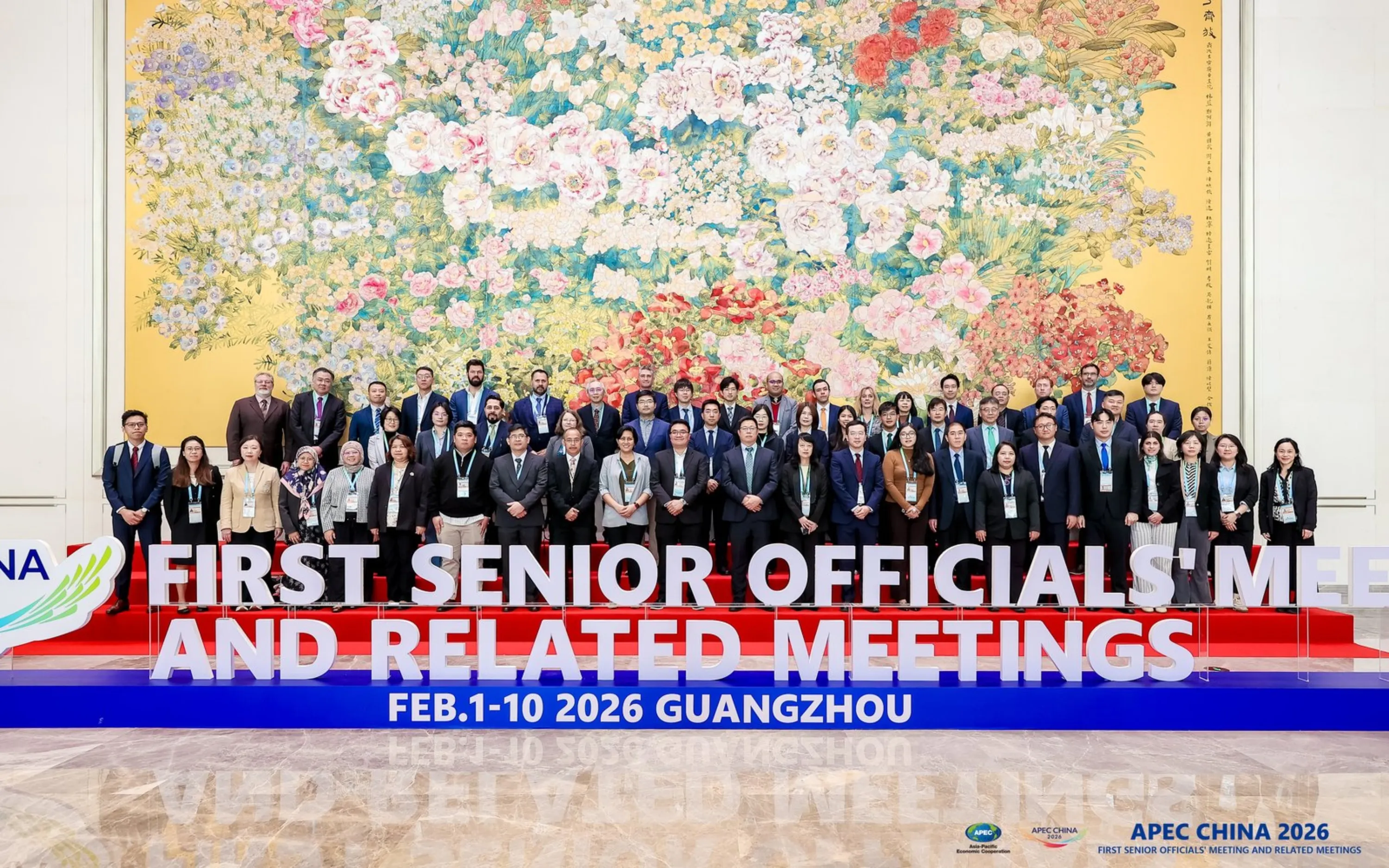
JASANZ was thrilled to be a part of Australia’s delegation to the Asia Pacific Economic Cooperation (APEC) proceedings last week at the first Senior Officials Meeting (SOM1) at Guangzhou, and which concluded on Tuesday.
Matt Pitt joined with Standards Australia’s Jesse Riddell, and Tim Sill from DFAT to represent Australia at the Sub-Committee on Standards and Conformance (SCSC), along with Standards New Zealand National Manager Malcolm MacMillan and Annette Gittos from the JASANZ ‘parent’ Ministry MBIE who represented New Zealand’s delegation, and our regional accreditation group, the Asia Pacific Accreditation Cooperation (APAC), represented by APAC Secretary Graeme Drake (Ged).
Representatives from regional and global standards bodies Pacific Area Standards Congress (PASC), ISO, IEC, ASTM, and metrology bodies such as OIML were also present. The SCSC is overseen by the APEC Committee on Trade and Investment (CTI), and the latter words are a primary consideration in all discussions.
The Australian delegation also had specific queries from other government agencies to follow-up on at the meeting, and proceedings including discussion of specific projects and workshops to apply standards and conformance solutions in areas such as:
- Addressing technical barriers to trade through APEC Centre of Excellence for Paperless Trade Workplan (digital transformation), of direct relevance to the DFAT FTA Certificate of Origin Scheme which allows Australian exporters market access and preferential tariffs with FTA partners;
- Harmonising standards and conformance for electronic household appliances in APEC Region, of direct relevance to electrical safety schemes operating under JASANZ accreditation and the IECEE CB Scheme for which JASANZ is the AU Member Body;
- An initiative by Emily McIntyre (Manager, International Policy, Standardization Services) at Standards Council of Canada for APEC harmonised standards and conformance in goods and services for disability inclusion, accessibility, employment, and rehabilitation including brain-device interfaces such as those developed by Dr Bing (Barry) Cui from the China Electronics Standardization Institute, and other expert contributors to ISO/IEC JTC1/SC43, of direct relevance the NDIS Commission’s NDIS AQA Scheme, the Global Accreditation Cooperation ISO 13485 (medical devices) Scheme for which JASANZ is Co-Convenor, and the Medical Device Single Audit Program (MDSAP) for which the Australian Therapeutic Goods Administration was immediate Chair;
- Regulatory practices that facilitate standards and conformance, and vice-versa, in emerging technologies such as artificial intelligence and biotechnology, through mechanisms such as Mutual Recognition Arrangements and Free Trade Agreements, and Quality Infrastructure policy;
- Carbon reduction in urban waste water and electrification infrastructure for road transport, and product labelling schemes for carbon claims including Chinas’ Product Carbon Labeling Certification System led by the Certification and Accreditation Administration of China;
- Shaping Digital Transformation in Accreditation; And lastly,
- International Standards Olympiad for school kids, the coolest discussion topic of them all! The application period for this year is TBC but likely May 2026. Founded in 2006 by the Korean Agency for Technology and Standards (KATS) as a program for youth aged 12–18, the Standards Olympiad has grown into a global competition since 2014, welcoming students from around the world.
APEC China’s theme this year is Building an Asia-Pacific Community to Prosper Together, with openness, innovation, and cooperation, and we look forward to progressing our work from SOM1 and contributing again in SOM3 in August.