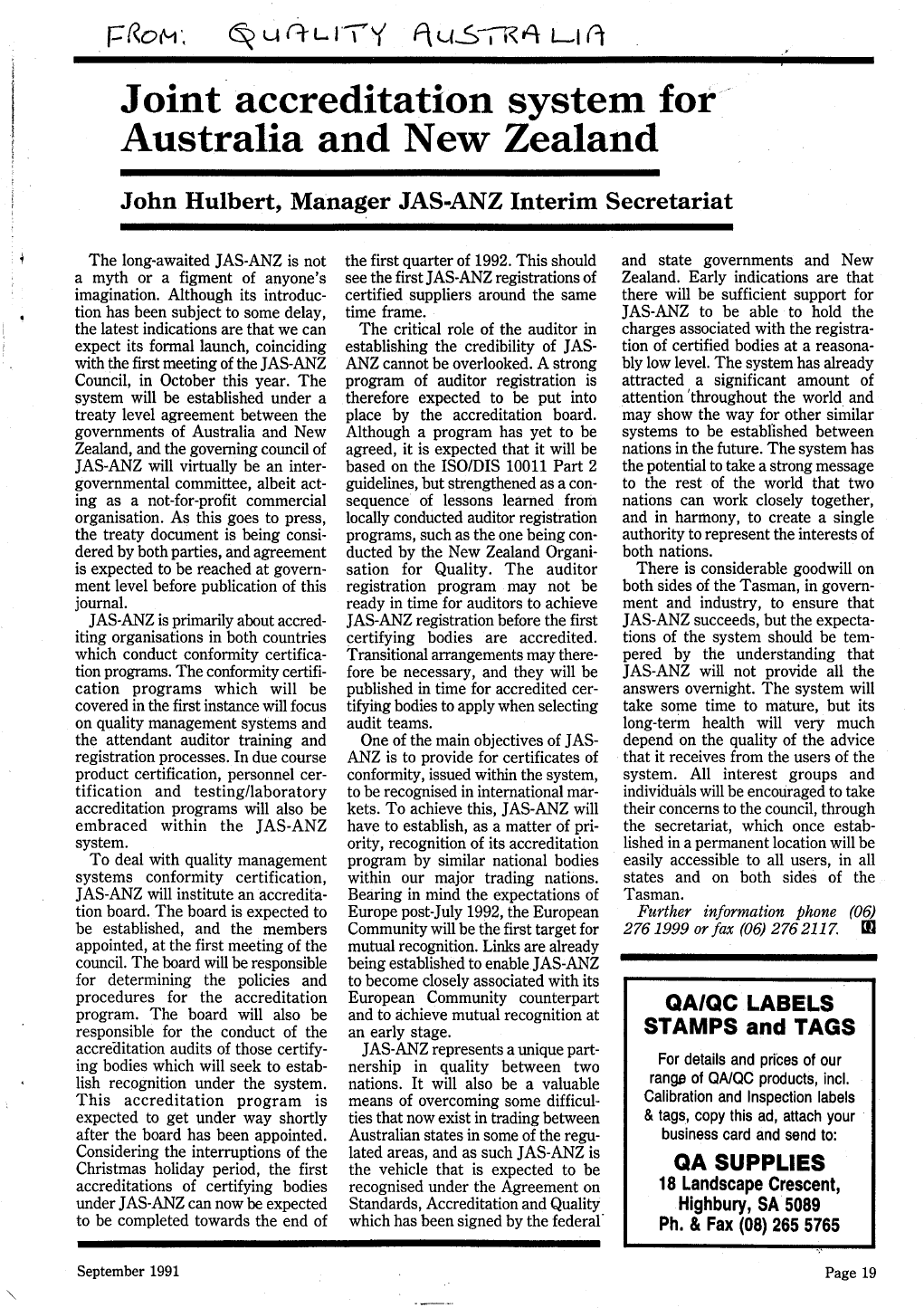
Celebrating 35 Years: 1991 Article in Quality Australia

The long-awaited JAS-ANZ is not a myth or a figment of anyone’s imagination. Although its introduction has been subject to some delay, the latest indications are that we can expect its formal launch, coinciding with the first meeting of the JAS-ANZ Council, in October this year. The system will be established under a treaty level agreement between the governments of Australia and New Zealand, and the governing council of JAS-ANZ will virtually be an inter-governmental committee, albeit acting as a not-for-profit commercial organisation. As this goes to press, the treaty document is being considered by both parties, and agreement is expected to be reached at government level before publication of this journal.
JAS-ANZ is primarily about accrediting organisation in both countries which conduct conformity certification programs. The conformity certification programs which will be covered in the first instance will focus on quality management systems and the attendant auditor training and registration processes. In due course product certification, personnel certification and testing/laboratory accreditation programs will also be embraced within the JAS-ANZ system.
To deal with quality management systems conformity certification, JAS-ANZ will institute an accreditation board. The board is expected to be established, and the members appointed, at the first meeting of the council. The board will be responsible for determining the policies and procedures for the accreditation program. The board will also be responsible for the conduct of the accreditation audits of those certifying bodies which will seek to establish recognition under the system. This accreditation program is expected to get under way shortly after the board has been appointed. Considering the interruptions of the Christmas holiday period, the first accreditation of certifying bodies under JAS-ANZ can now be expected to be completed towards the end of the first quarter of 1992. This should see the first JAS-ANZ registrations of certified suppliers around the same time frame.
The critical role of the auditor in establishing the credibility of JAS-ANZ cannot be overlooked. A strong program of auditor registration is therefore expected to be put into place by the accreditation board. Although a program has yet to be agreed, it is expected that it will be based on the ISO/DIS 10011 Part 2 guidelines, but strengthened as a consequence of lessons learned from locally conducted auditory registration programs, such as the one being conducted by the New Zealand Organisation for Quality. The auditor registration program may not be ready in time for auditors to achieve JAS-ANZ registration before the first certifying bodies are accredited. Transitional arrangements may therefore be necessary, and they will be published in time for accredited certifying bodies to apply when selecting audit teams.
One of the main objectives of JAS-ANZ is to provide for certificates of conformity, issued within the system, to be recognised in international markets. To achieve this, JAS-ANZ will have to establish, as a matter of priority, recognition of its accreditation program by similar national bodies within our major trading nations.
Bearing in mind the expectation of Europe post-July 1992, the European Community will be the first target for mutual recognition. Links are already being established to enable JAS-ANZ to become closely associated with its European Community counterpart and to achieve mutual recognition at an early stage.
JAS-ANZ represents a unique partnership in quality between two nations. It will also be a valuable means of overcoming some difficulties that now exist in trading between Australian states in some of the regulated areas, and as such JAS-ANZ is the vehicle that is expected to be recognised under the Agreement on Standards, Accreditation and Quality which has been signed by the federal and state governments and New Zealand. Early indications are that there will be sufficient support for JAS-ANZ to be able to hold the charges associated with the registration of certified bodies at a reasonably low level. The system has already attracted a significant amount of attention throughout the world and may show the way for other similar systems to be established between nations in the future. The system has the potential to take a strong message to the rest of the world that two nations can work closely together, and in harmony, to create a single authority to represent the interests of both nations.
There is considerable goodwill on both sides of the Tasman, in government and industry, to ensure that JAS-ANZ succeeds, but the expectations of the system should be tempered by the understanding that JAS-ANZ will not provide all the answers overnight. The system will take some time to mature, but its long-term health will very much depend on the quality of the advice that it receives from the users of the system. All interest groups and individuals will be encouraged to take their concerns to the council, through the secretariat, which once established in a permanent location will be easily accessible to all users, in all states and on both sides of the Tasman.